
‘V Questions with…’ uncovers the backstory to a RISC-V member’s latest work in five questions. Here, I talk to Dr. Jianyi Meng, Chief Scientist at Alibaba DAMO Academy and Vice Chair of RISC-V Summit China 2026, about what it took to achieve an on-chip AI milestone for RISC-V, and his hopes for next week’s Summit in Shenzhen.
2026 has been a defining year for high-performance RISC-V computing. Several vendors have brought high-performance silicon to market, built around the RVA23 profile and targeting demanding AI and data center workloads. Meanwhile, upstream RVA23 support in major Linux distributions enables compatible platforms to run mainstream software out of the box. RISC-V International ratified the Server Platform specification earlier this year, and more recently we saw industry-standard GPU acceleration platforms NVIDIA CUDA and AMD ROCm running on RISC-V host servers.
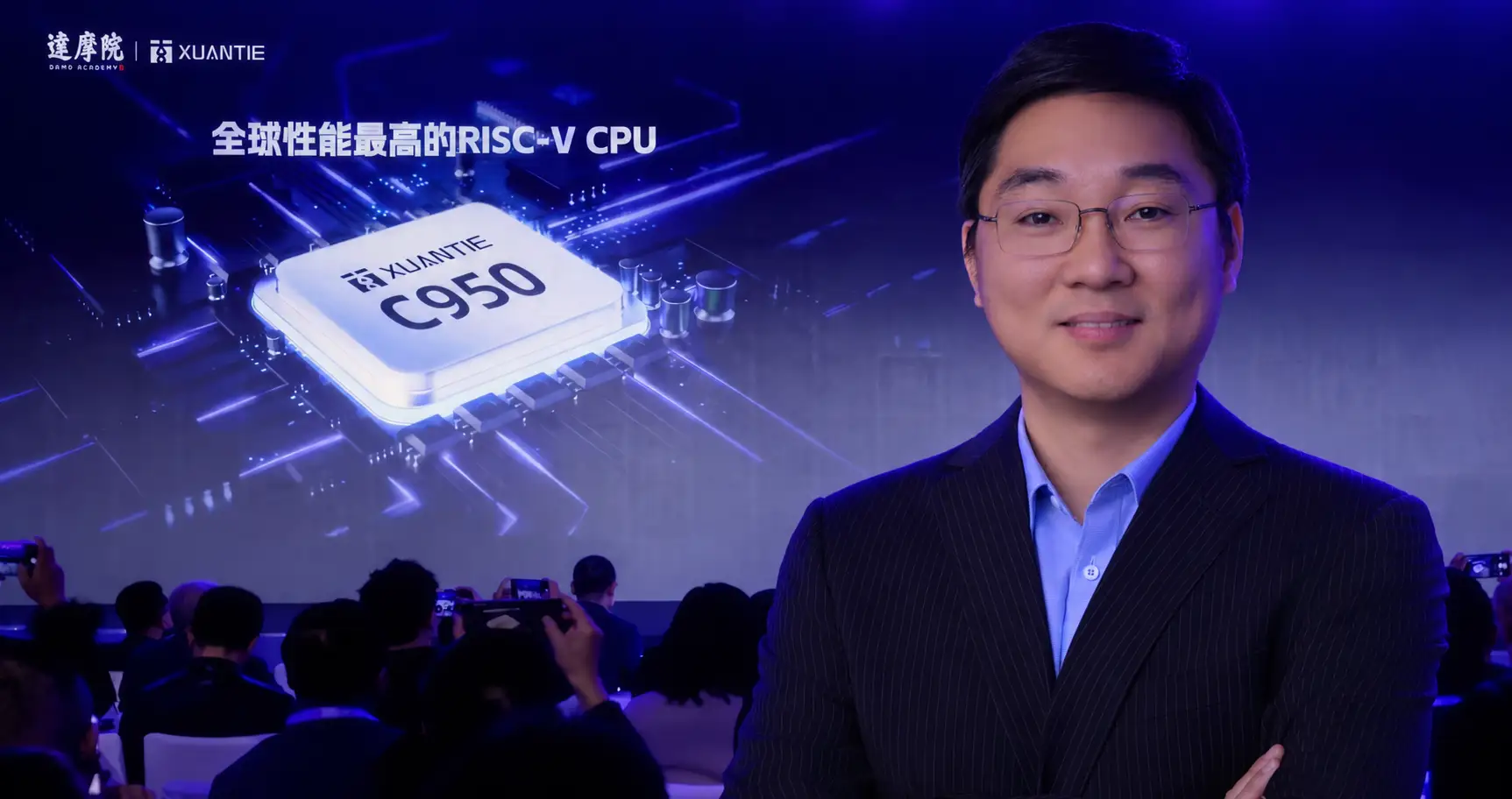
And the milestones keep coming. A few weeks ago, I talked to the CEO and GM/CFO of Openchip about BER10, the sovereign RISC-V processor designed in Europe and taped out in under two years. Now I’m exploring another landmark achievement from Alibaba’s XuanTie team. It ran Qwen3.8-27B, a substantial 27-billion-parameter large language model (LLM) from the company’s Qwen AI family, natively at more than 30 tokens per second. All on a 64-core target configuration of its RISC-V-based C950 processor, without a separate GPU or NPU to accelerate the AI workload.
AI throughput figures can be difficult to interpret in isolation, so let me put that number into context. 30 tokens per second equates to roughly 20–22 words per second, comfortably fast enough for natural, real-time conversation. Achieving this requires a memory architecture capable of moving approximately 400 gigabytes of data every second. By comparison, a high-end gaming PC processor without a discrete accelerator might manage 5–15 tokens per second with the same model.
Alongside high-bandwidth (or unified) memory, a capable processor needs hardware acceleration built directly into the CPU itself. That’s where XuanTie’s high-performance flagship, C950, comes in. Developed by Alibaba DAMO Academy, it’s a server-class 64-bit superscalar processor designed to bridge traditional HPC demands and heavy agentic AI workloads. The team built it to meet the RVA23 profile, which mandates the RISC-V Vector extension (RVV 1.0).
AI uses vectors, but LLMs also depend heavily on multiplying matrices – rectangular grids of numbers that hold a model’s weights and the data flowing through it. To speed up that multiplication, XuanTie developed its own proprietary custom extension to accelerate matrix math.
Having validated its own matrix extension in silicon, the team – together with Qualcomm, IBM, VRULL, ISCAS, BOSC and other member organizations – launched the AME (Attached Matrix Extension) task group to refine and advance the proposal through the RISC-V standards process, and is now actively driving this community-polished specification toward ratification as an official extension.
DAMO Academy’s Chief Scientist, Dr. Jianyi Meng, led the team behind XuanTie’s C910 and C920 cores, and received the China Computer Federation’s 2023 Outstanding Engineer Award – one of the most prestigious honors bestowed by China’s computing community, presented annually to a select few whose work has fundamentally reshaped the trajectory of the industry.
Having chaired RISC-V Summit China in 2024, he returns as vice-chair for this year’s event, which runs from this Sunday, October 18. Ahead of the Summit, I asked Dr. Meng to take us from that Qwen result to the doors of the Shenzhen Convention and Exhibition Center…
1What were the biggest technical challenges in achieving 30 tokens per second on a RISC-V CPU without a discrete GPU or NPU?
Dr. Meng:The biggest challenge is co-design. For a very large model such as Qwen3.8-27B, quantization, matrix instructions, on-chip memory, memory bandwidth, and kernel-level optimization have to be co-designed as a single system. Raw compute matters little in isolation; it’s balancing computation, data movement, and software optimization that counts.
The prefill phase is dominated by dense matrix math, which is why dedicated instructions for low-precision matrix operations are essential. Once inference moves into token-by-token decoding, model weights must stream continuously from memory into the compute units, and the bottleneck typically shifts to memory bandwidth.
At the same time, on-chip caches, interconnect, and data reuse must be efficient enough; otherwise, the compute units simply stall waiting for data. Only then can a CPU deliver practical decode throughput without a discrete accelerator.
2What makes the XuanTie C950 a strong place to start for a high-performance RISC-V processor for AI in 2026?
Dr. Meng:Software optimization for high-performance and AI workloads on RISC-V is still maturing, so the hardware has to take the first step. The C950 adopts the RVA23 profile as its general-purpose compute baseline, unlocking software portability. As it becomes the common software baseline for 64-bit RISC-V application processors, Linux, compilers, and foundational software will increasingly align around it.
Then, the addition of XuanTie’s matrix compute capability lets users explore RISC-V’s performance potential in emerging general-compute and AI use cases early on. Customers who choose this architecture today get both immediate performance and a path into a more unified ecosystem over time.
3Like the RISC-V AME, your matrix extension keeps its own separate ’tile’ registers rather than computing inside vector registers. What made this right for the C950 (and the C907 before it)?
Dr. Meng:We chose dedicated matrix registers primarily to prevent matrix operations from contending with general-purpose vector work over the same RVV register file. Matrix kernels need to hold tiled operands and wide accumulators resident for extended periods. Reusing the vector registers entirely would increase vector register pressure, drive additional spill-and-fill traffic to the stack, and disturb cache utilization, which in turn degrades vector execution in general-purpose code.
Separate tile and accumulator registers let data stay resident longer and naturally support mixed-precision accumulation (INT4 and INT8 into INT32, or FP4, FP8, FP16, and BF16 into FP32). The design also gives compilers and the operating system room to enable matrix state on demand, and to save or restore it only when necessary, rather than incurring matrix-state management overhead on every ordinary context switch.
4You helped initiate the RISC-V AME task group after building your own matrix extension into silicon. What did that design process teach you that the task group might have otherwise missed?
Dr. Meng:We learned that a specification cannot stop at defining the matrix-multiply instruction. It must also address matrix dimensions and data layout, dedicated accumulator registers, rounding and saturation behavior under mixed precision, data movement, context save and restore, exceptions and virtualization, and compiler and ABI mapping.
Meanwhile, capabilities such as FP8, INT4, and sparsity continue to evolve rapidly alongside the algorithms themselves. Our experience is that a standard must offer a sufficiently unified software interface, while still leaving headroom for algorithmic innovation and microarchitectural evolution.
At the same time, collaboration with other industry players through the community enables the pooling of collective engineering experience and technical expertise, providing essential support for shaping a specification that is both substantively valuable and closely aligned with industry needs.
5What sort of ecosystem momentum are you hoping to see at RISC-V Summit China in Shenzhen this year?
Dr. Meng:I’m hoping to see evidence of the ecosystem closing the gap in the most demanding environments. I’d highlight three areas:
First, high-performance data center ecosystems still have a long road ahead for full RISC-V adoption. We’ve already taken the first step on Java runtime adaptation. The results have been very encouraging, and we’ve contributed the work back to the community. I’m hoping to see more efforts like this, tackling the kind of complex, high-performance software stacks that mission-critical deployments depend on.
Second, CPUs are increasingly capable of supporting AI workloads, but hardware alone isn’t enough. What we need is the full software chain to catch up. Optimized operator libraries, updated compilers, and a stack that lets RISC-V serve effectively as an xPU, while enabling tighter chip-model co-design. That’s where real competitiveness will come from.
Third, RISC-V’s greatest untapped potential lies in architectural innovation. The openness of the ISA gives us a unique opportunity to explore new extensions and compute paradigms. I’d love to see the community push harder on that – because if we do, RISC-V won’t just catch up to existing architectures; it will redefine what’s computationally possible.
RISC-V Summit China 2026
RISC-V Summit China opens this Sunday at the Shenzhen Convention and Exhibition Center, bringing together leading scientists, core architects, industry executives, technology developers, and ecosystem partners. Registration remains open – click below for details.