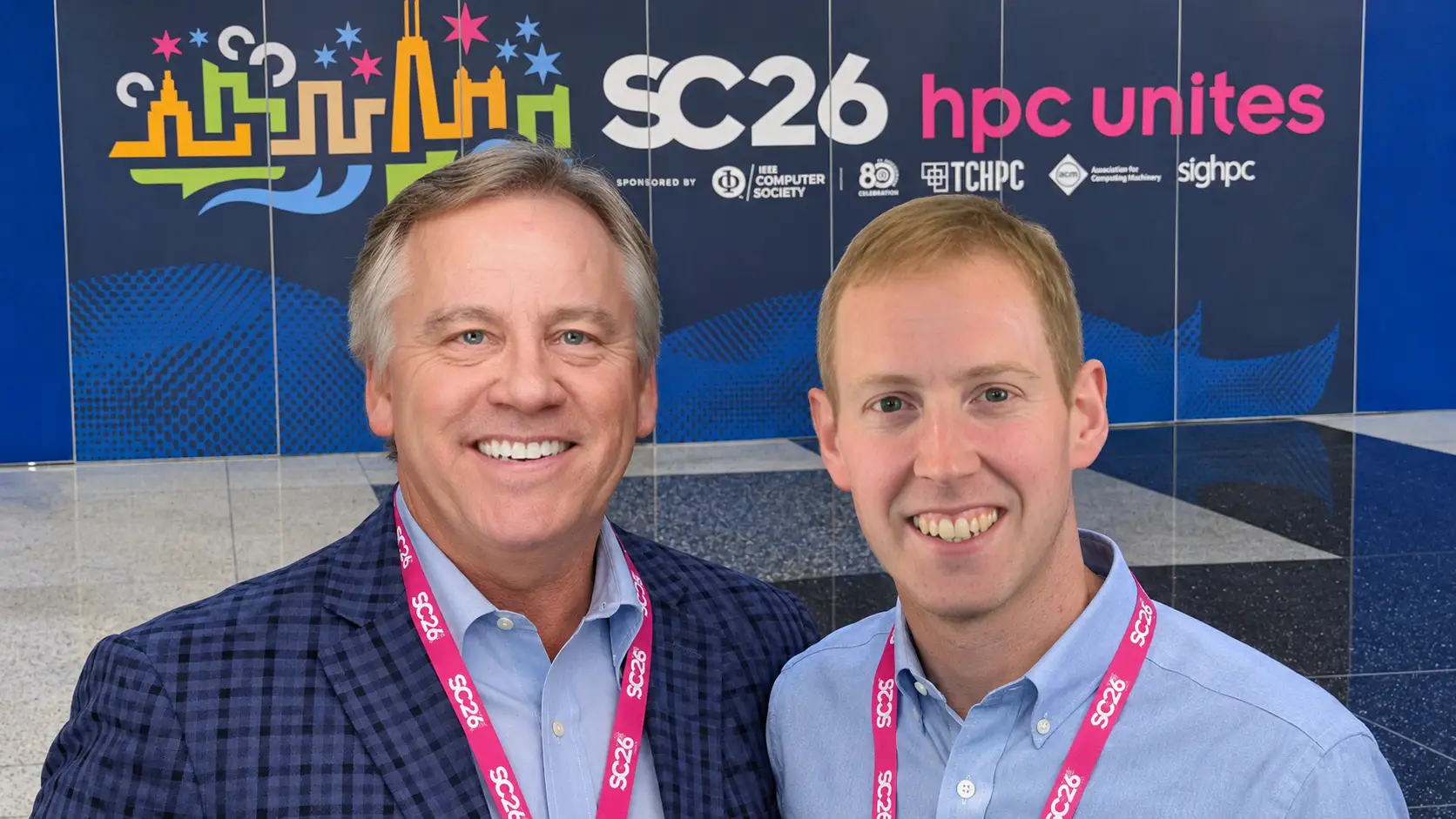

Article 50(4) note: Nick and Doug did their best to find each other at the packed SC26 show this week, but in the end we did this interview virtually. The above image is an AI composite created from individual headshots.
‘V Questions with…’ uncovers the backstory to a RISC-V member’s latest work in five questions. Ahead of the world’s premier supercomputing conference, SC26, I talk to Doug Norton [left, above], Chief Marketing Officer at Inspire Semiconductor and President of The HPC-AI Society, and Dr. Nick Brown [right, above], Senior Research Fellow at EPCC (the UK national supercomputing centre, based at the University of Edinburgh).
The International Conference for High Performance Computing, Networking, Storage, and Analysis – mercifully abbreviated to SC26 – is currently in full swing in Chicago. The event has brought the supercomputing community together every year since 1988, and SC25 in St. Louis drew more than 16,500 attendees and a record 524 exhibitors.
It’s also the last big event of a year that has been very good to high-performance RISC-V. A number of vendors have taped out server-grade silicon built on the RVA23 profile, and the Server Platform specification has been ratified. Earlier in this series, I talked to Openchip about BER10, its sovereign European processor, and to Alibaba DAMO Academy about running a 27-billion-parameter LLM on a RISC-V CPU, with no GPU in sight.
But ‘high performance’ covers a lot of ground, and the terms tend to get blurred together.
A data center is a building full of servers running thousands of separate jobs for thousands of users at once: websites, databases, cloud services, and, increasingly, AI inference. Operators measure success in cost and energy per job.
High-performance computing (HPC) pools many machines to solve problems too big for any one of them – such as engineering simulation, weather forecasting, drug discovery, and AI training. An HPC cluster might belong to a university department or a car maker’s engineering team.
Then, at the very top end of HPC, there’s supercomputing. A supercomputer is a single system of thousands of tightly linked nodes, all working on one problem at once, often in 64-bit double-precision floating point (FP64). The biggest belong to national labs and research centers, and the fastest are ranked twice a year on the TOP500 list, with the November edition announced at SC.
It’s at that top end that Nick and Doug work, alongside projects such as DARE, which the EuroHPC Joint Undertaking is funding to develop RISC-V technologies for future European supercomputers. Nick chairs RISC-V International’s HPC Special Interest Group (SIG) and leads the RISC-V for HPC workshop series at ISC and SC. He’s also principal investigator for the RISC-V testbed at EPCC, home to ARCHER2, the UK’s national supercomputer.
As vice-chair of the HPC SIG and CMO of InspireSemi, Doug has a foot in both the wider RISC-V HPC community and its commercial ecosystem. He is currently taking Thunderbird – the company’s RISC-V accelerator for HPC and AI – to market, with partners including Lenovo, Dell Technologies, Penguin Solutions and E4 Computer Engineering helping to pave the way for its commercial deployment in PCIe accelerator cards and HPC servers.
Ahead of the show, I asked Nick and Doug how the supercomputing world is waking up to RISC-V…
1You’ve both been flying the flag for RISC-V HPC at the SC Conference Series for a number of years now. How have the conversations evolved?
Nick:When we first presented RISC-V at ISC High Performance 2023, it was very much an early exploration: simulators and/or basic RISC-V hardware that explored the art of the possible, and garnered a fair bit of skepticism from the wider community.
In the 3-4 years since then, more than 50 papers exploring the role of RISC-V in HPC have been published through the RISC-V HPC workshop series we’ve run at ISC, HPC Asia and SC conferences, and we’ve hosted numerous panels and Birds of a Feather (BoF) community sessions. These are important venues that not only share what is going on, but also connect RISC-V to HPC and build momentum.
When I first set up the EPCC RISC-V testbed, we relied very heavily on simple embedded boards, but RISC-V is now scaling rapidly in both core count and core performance. Combined with our efforts to engage the HPC community, access to increasingly powerful RISC-V processors and accelerators is fundamentally changing the conversation from what’s possible to what’s becoming practically achievable.
Doug:Certainly from the conversations I’ve had in 2026, that momentum is getting recognized. A few years back, I’d meet with industry analysts and large customers and their initial comment would be along the lines of “it will take 5–10 years for RISC-V to be in HPC, if at all.” In a relatively short timeframe we’ve gone from “there really is no RISC-V in HPC” to RISC-V in HPC happening globally, out in the open.
22026 has been high-performance RISC-V’s year, with a number of server-grade tapeouts. How have recent developments changed confidence in RISC-V in supercomputing?
Doug:Data centers are now mainly AI data centers, and that convergence is spreading to supercomputing. Customers deploying new, large systems are increasingly using them for both AI and HPC, not one or the other. Some organizations no longer differentiate between HPC and AI at all – they use terms like Advanced Computing or AI supercomputing.
Nick:Personally I think conflating the two overlooks the decades that HPC has spent tackling ‘traditional’ scientific and engineering workloads. But it’s true that the things that AI needs are the same things other supercomputing workloads need – and it’s proving hugely beneficial to RISC-V in supercomputing, because it’s driving technological innovation in the right places. A good example is RISC-V accelerators designed for AI that are proving ideal for ‘traditional’ HPC workloads – evidenced by numerous success stories published in the RISC-V for HPC workshop series.
Doug:The RISC-V AME/IME/VME matrix extensions will be key milestones in the coming years. We’ve already seen CPU-based supercomputers (using wide vector units and matrix multiplication capabilities) knock GPU-based systems off the top spot of the TOP500 supercomputing list. A RISC-V-based supercomputer has every opportunity to do the same; there’s a strong sense of confidence in RISC-V in this market, since it grew up alongside open source software, which AI is built on. Couple that with the fact that nobody likes vendor lock-in, and it’s kind of amazing that it took this long to have an open CPU hardware standard.
With RISC-V and its different application profiles, software developers and enterprises can be confident there will be a wider range of vendors who can provide more diverse and/or specialized computing solutions compared to a few incumbents. Our Thunderbird compute accelerator, which is essentially a RISC-V-based supercomputer on a chip, is a great example of this – we can pack 1,536 native FP64 CPU cores on a single chip that’s half the size of competitors’.
3What will it take to bring the full supercomputing software stack to the RISC-V ISA?
Nick:We need to focus on filling the gaps, and optimizing what we’ve already filled. Last year the HPC SIG completed a gap analysis and found that 55% of users of the UK’s national supercomputer (an HPE Cray EX) could run their code on RISC-V. This was actually higher than I had anticipated – but of course, “runs on” does not necessarily mean “optimized for.” So a lot of effort has been going on single-node optimization, for example making codes run faster with vectorization, exploiting things like long and scalable vectors, which RISC-V’s Vector extension (RVV) provides.
We also need help from RISC-V members: you will undoubtedly have things to contribute, even if they’re not specifically focused on supercomputing. For example, earlier in the year Openchip upstreamed patches into the Lustre HPC filesystem to make it available for RISC-V – filling an important gap for us.
Doug:We need to keep laser-focused on openness. I lived this early in my career at IBM when we launched the POWER systems. We initially focused POWER on HPC, supplying our own version of Unix and most of the software and tools needed. When POWER expanded into the enterprise data center, it took a very long time to port and optimize the low-level software and middleware, then an equally long time to encourage commercial vendors to port and optimize their own software stacks.
This is why RISE (RISC-V Software Ecosystem) is so important. It focuses on getting the RISC-V software stack ready, from firmware and kernel up to compilers and toolchains. With Thunderbird, we build on that stack and the open standards and software this industry uses (MPI, OpenMP, and Zephyr RTOS for edge use cases), rather than creating something bespoke. We also support all the standard OSs, compilers, LLVM, libraries, debuggers, AI frameworks, etc. that are used for HPC and AI. The work done by the RISC-V data center SIG really benefits us, too.
4How valuable to supercomputing is the assurance of long-term architectural stability that comes with an open standard ISA?
Nick:Very, but not for the same reasons as in automotive or edge AI. Those applications need hardware that can last decades, whereas supercomputers have surprisingly short lifetimes – 5, maybe 8 years – because the pace of hardware innovation moves so quickly. Meanwhile, quite a few HPC codes are 30 or 40 years old (with lots of updates along the way!) Keeping that software running across successive generations of incumbent architectures has traditionally caused us significant headaches.
That’s where I believe RISC-V has the potential to make a real difference. It gives us a common, open standard ISA that our software can run on today, and continue to target for years to come. The jury is still out on how much a particular vendor’s implementation might affect software portability, but there are already things we can do – optimizing for the RISC-V vector extension (RVV), for instance – that help us carry codes across implementations.
Doug:Nick is spot on. Customers know their most valuable asset is their software, as it has often taken decades to create, and embodies their IP and business processes. They’re accustomed to hardware refreshes every five years or so, as warranties expire and new generations of hardware bring performance and energy-efficiency gains.
Nick:We actually had a panel at SC25 all about open standards in HPC, with RISC-V a major component on the hardware side. That explored the full-stack approach and the benefits it can bring. Ultimately, I think it will be a question of bringing numerous technologies together that all rely on open standards, with RISC-V being a cornerstone because it provides that all-important hardware-software interface.
Doug:RISC-V provides more choice, competition, and long-term stability than any alternative. Customers don’t have to worry about a particular computer company going out of business or end-of-lifing the architecture, which has happened many times in this industry.
5What do you most want SC26 attendees to take away about RISC-V this week?
Nick:When people think of RISC-V, they often think of it as the “next big thing”. I want people to realize that it’s very much here, deployed and already making a big impact in HPC. There are a whole load of RISC-V vendors with booths at SC26 this week, and we also have two formal RISC-V activities.
Firstly, we’re running a community Birds of a Feather (BoF) session on Thursday lunchtime (12:15–1:15pm) bringing people together to discuss the current state of RISC-V, the latest developments, and where we still need to go. Secondly, a workshop on Friday morning (8:30–12:00pm). These sessions get busier every year, with a number of great speakers and papers describing the state of the art.
Doug:I’d second that. These are some great opportunities to fill any knowledge gaps you may have, learn how you can get involved, and network with others in the RISC-V ecosystem. As Nick says, there are a number of RISC-V vendors with booths on the exhibit floor; be on the lookout for the RISC-V Member placards, as RISC-V is in many more products than you might expect!
If you’re at SC26, the RISC-V Birds of a Feather session runs on Thursday, November 19, and the RISC-V for HPC workshop on Friday, November 20.
One talk not to miss will be given by the Workshop’s invited speaker, our VP of Technology, Tom Gall. It’s titled ‘High RISC, High Reward: The Journey from Ratified Specs to RVA23 Superclusters‘, and if you’re attending SC26, be sure not to miss it. If you’re not attending but want a primer on RISC-V’s journey, Tom’s title pays homage to my history of RISC-V article: if you’re new to the RISC-V ecosystem it’s a great place to start.
Join Nick and Doug at SC26
The RISC-V ecosystem Birds of a Feather session “HPC Next: Reflections and Progress on the RISC-V Ecosystem” at SC26 on Thursday, 19 November, runs from 12:15 to 1:15pm CST in Room W183b. Nick Brown will lead the session, joined by Doug Norton alongside representatives from E4 Computer Engineering, NextSilicon, RISC-V International, Forschungszentrum Jülich, and MIT.