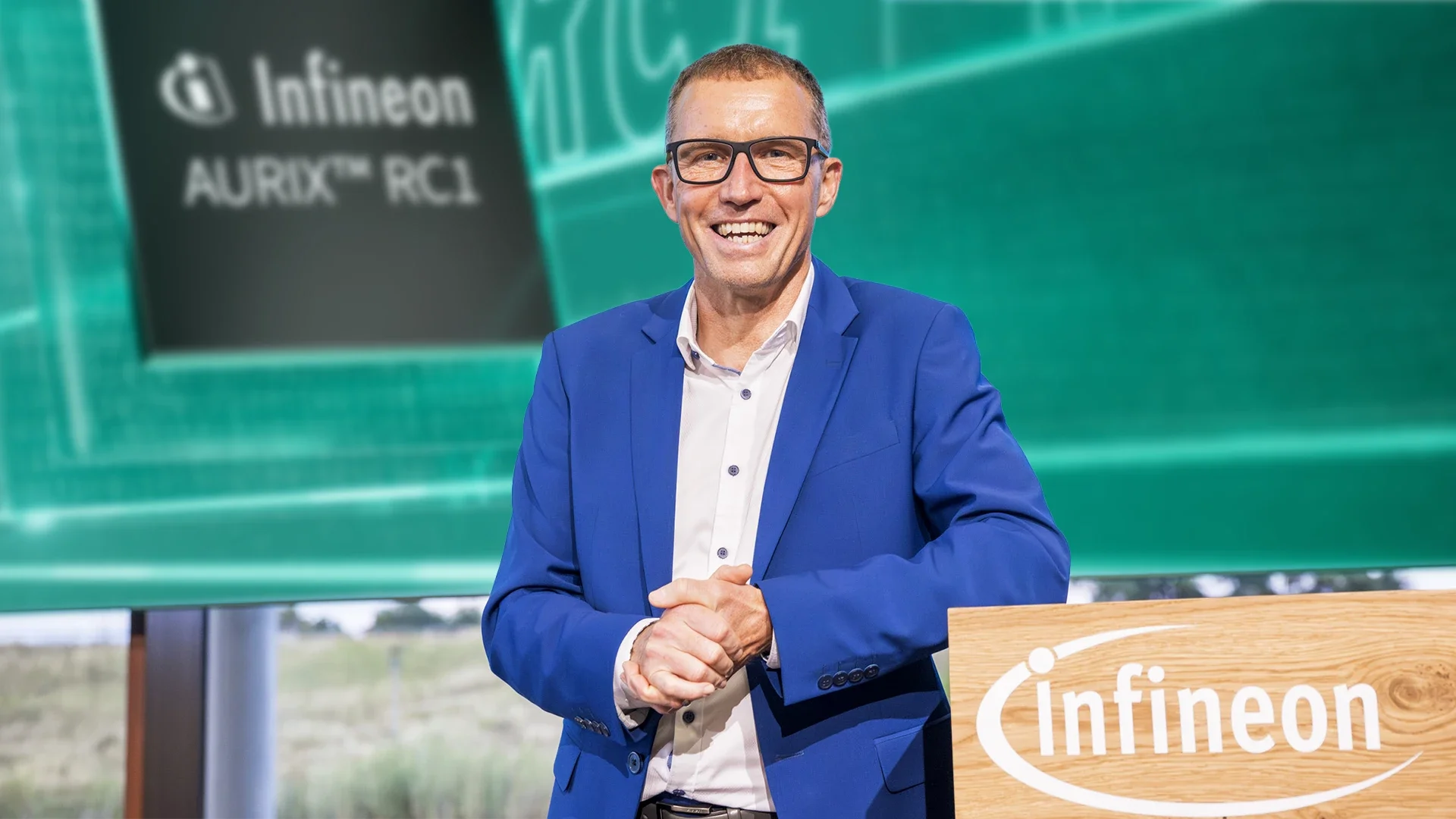

‘V Questions with…’ uncovers the backstory to a RISC-V member’s latest work in five questions. With AURIX™ RC1, Infineon is taking AURIX (the microcontroller family its automotive business was built on) to the RISC-V ISA. I ask Infineon’s VP of Software and Ecosystem Management for Automotive Microcontrollers, Thomas Schneid, what this means for automakers putting AURIX at the heart of their latest vehicle platforms.
On November 4, Infineon announced AURIX™ RC1: the chipmaker’s first microcontroller family built on the RISC-V instruction set architecture (ISA). While the specific line-up has yet to be detailed, AURIX RC1 is designed to redefine real-time compute and control for next-generation software-defined vehicles (SDVs), as well as wider software-defined everything (SDX) and physical AI applications.
AURIX is the family upon which Infineon built its automotive microcontroller business, and it remains the flagship for the chipmaker’s automotive division as well as being the driving force behind the company’s prominent market position. To put that position into perspective, Infineon supplied over a third of automotive microcontrollers globally in 2025, according to TechInsights.
”Infineon has worked very hard to ensure that the effort required for automakers to move to RISC-V, and the impact on a customer's toolchain, is minimal.
Thomas SchneidVP of Software, Partner and Ecosystem Management, Infineon Technologies
So this is the story of a market leader moving its flagship family to the RISC-V open industry standard. In doing so, Infineon brings the strengths of its existing AURIX TriCore and TRAVEO™ T2G families together into one generation. It scales from real-time controllers up to hybrid MCU/MPU devices, for zonal, body, chassis, battery management, powertrain, driver-assistance safety management, and cockpit applications. For customers, that means the ability to deploy workload-specific silicon on one common foundation across the vehicle. Selected AURIX RC1 implementations will also feature a parallel processing unit (PPU) for accelerated AI, taking the automotive industry a step closer to the concept of pervasive AI in automotive – from real-time physical AI at the vehicle edge to agentic AI experiences in the digital cockpit.
Thomas Schneid is VP of Software, Partner and Ecosystem Management at Infineon Technologies, and has spent the last few years preparing the software and partner ecosystem around AURIX for this move. I sat down with Schneid to ask why Infineon moved now, how much really changes for its customers, and why an open standard matters for a car that may still be on the road in 25 years…
1What made this the right moment for Infineon to embrace RISC-V with AURIX™ RC1?
Thomas:Especially in the SDV environment, customers are defining their platforms for the next decade right now. AURIX has served the dependable microcontroller market very successfully for many years, and we will continue to support our existing MCU families for many more. But more and more, customers want choice. They have told us they want to reshape their software stack, they want more openness and the flexibility to orchestrate their software supply chain – to pick and choose.
That’s not something a proprietary architecture, however good it is, was designed for. So we looked at our options very carefully. RISC-V became the clear decision, because it enables us to build on the footprint we already have in this space. It moves us towards an open standard, and it gives our customers the freedom of choice and economic control over components and partners that they’ve been asking for.
With AURIX RC1, we take the family’s key strengths – real-time compute and control – and we take them further, to the next generation of SDV, SDX, and physical AI applications, where customers need more performance and more scalability, but still the dependability they know from AURIX.
2How significant is the transition to RISC-V for Infineon, and for your customers?
Thomas:For Infineon, it is very significant. Our MCU business is no longer focused on the black box. We’ve taken the performance, scalability, safety and security, power efficiency, connectivity, and edge AI capability that the AURIX family is known for, and rebuilt it on the RISC-V open standard.
For our customers, though, this in fact not significant… it’s business as usual. Of course, it’s significant in its benefits: greater ease of use and faster time to market, and they still keep the flexibility to choose different components. It becomes a more open space where many players can contribute, and where we can help to orchestrate the decisions together with our partners.
But we have worked very hard to ensure that the effort required to move to RISC-V, and the impact on a customer’s toolchain, is minimal. Their application software is written against AUTOSAR interfaces and our MCAL, and we have prepared the DRIVECORE ecosystem so that moving from existing AURIX and TRAVEO T2G platforms to AURIX RC1 can be as smooth as possible.
Nobody has to move on day one; customers can move to AURIX RC1 when it fits their program. When they do, they get more options: more flexibility in their software supply chain, more choice of components and features, and an architecture which no single entity controls.
3How does RISC-V enable Infineon’s customers to unify multiple automotive applications under a single open ISA?
Thomas:Today a vehicle has many different kinds of microcontrollers: in the zones, in the body, in the chassis, in battery management, in powertrain, in driver-assistance safety management, and in the cockpit. Traditionally, each domain got its own point solution. With AURIX RC1 we give engineering teams one common MCU basis for all of these, and RISC-V is what makes this possible.
On one side it scales, from a small real-time controller up to hybrid devices. On the other side it gives our customers the workload-specific silicon they need to span many very different applications in the vehicle, from deterministic control loops up to edge AI. RISC-V is the only ISA that can do both on one single architecture, and the result is a lot of code portability.
AURIX RC1 gives them 12 32-bit MCU product family members, a parallel processing unit for edge AI, and up to 40 MB of embedded memory. A higher-end lineup will add 64-bit microprocessor capabilities for consolidation into central computers. Selected devices also integrate Ethernet switching, which can reduce external components. For Physical AI this is important: the controller senses and acts in real time, close to the sensors and actuators, with AI acceleration on the same chip.
So yes, the tools, the know-how, and a lot of the software can travel. I would be careful to say that one binary runs everywhere, because a chassis controller and a cockpit device have different extensions and different safety requirements. But the compiler infrastructure, the debug environment, the middleware, and the engineers’ experience all move with you. For our customers, this means less effort to bring a new function into a different part of the vehicle, and faster time to market. And when it comes to things like safety, AURIX RC1 is designed to support applications up to ASIL D; with our partners we are building the qualified tools and documentation around it.
Ready to Discover Where the Open Road Leads?
Subscribe to RISC-V Automotive Insights for exclusive perspectives from companies shaping tomorrow’s software‑defined vehicles.
Delivered quarterly to your inbox. No detours.
4How do you reassure your customers contemplating a move to AURIX™ RC1 on things like software portability?
Thomas:The biggest concern we hear is very understandable: “My software is running fine. Why should I take the risk of moving to some new architecture?” Our answer is that this risk has been mitigated. Our customers’ application software is written in C or C++ against AUTOSAR interfaces, and our Microcontroller Abstraction Layer (MCAL) sits between this software and the silicon. When the core underneath changes, we update the MCAL, the compiler targets a new instruction set, and the application is recompiled, not written again from zero.
Of course, it is one thing to tell them, and another to show them. Reassurance comes when our customers see their own code running on the new architecture, with the tools they know, inside a safety process they trust. We prepared the ecosystem so they can check all three themselves, but we’re also with them every step of the journey. There is a deep level of trust and a high level of connectivity between Infineon and its partners, with expert-level discussions on a regular basis.
Of course, there is some work to do, as there would be with any new MCU generation – even within the same ISA. Low-level drivers and hand-written assembly code need porting, and timing and safety evidence must be confirmed on the new silicon. Our DRIVECORE virtual prototyping enables customers to start software development before hardware is available, and our AI-assisted migration tools help preserve their existing software investments.
5How does the adoption of an open standard in AURIX™ RC1 enable your customers to rethink vehicle architectures for the SDV era?
Thomas:In an SDV, the software lives much longer than one hardware generation. When you look on the road, you see many cars which are 25 years old. For all these years, somebody has to be able to deliver patches and updates. UN R155 requires vehicle manufacturers to respond to cybersecurity issues for the whole life of the vehicle. For this you need an architecture where the compilers, the tools, and the engineers who understand it are still there.
This is where openness is very important. The RISC-V ISA is an open standard and it does not depend on the fortunes of one company. For a customer who plans a vehicle program over ten or fifteen years and needs these vehicles to remain roadworthy for far longer, this gives a lot of confidence in their options, now and in the future.
Openness also changes how software and hardware come together. Customers want to have their own way of orchestrating their software supply chain. On an open standard, they can choose software components from different partners, and they can be sure those components speak the same language as the silicon. Security mechanisms, safety mechanisms: this is our job as the silicon vendor, and AURIX RC1 is designed for this. Its security mechanisms are intended to meet ISO/SAE 21434 and the Cyber Resilience Act, with crypto-agility and readiness for future requirements such as post-quantum cryptography, so customers can keep their vehicles secure as the potential threats change over the years. Meanwhile, the open standard underneath gives the customer the freedom, and the longevity.
Infineon is a committed contributor in the collaborative process of developing the RISC-V specification together with many other member companies – including Quintauris, which we are a founding member of. With a proprietary architecture you either do everything alone, or you depend on the roadmap of somebody else. With RISC-V we can contribute what automotive needs, and then compete with our own implementation on top.
While the move to RISC-V represents a fundamental shift in Infineon’s underlying architecture, the company has gone to great lengths to ensure that for its customers, this is evolution not revolution. Their AUTOSAR stack is recompiled, the tool partners they rely on stay the same, and they can move to AURIX RC1 when it suits their program.
In turn, Infineon’s customers gain the flexibility to pick and choose components, partners, and features, on an architecture no single company controls – and they’re likely to feel that last point more and more each year the vehicles they sell remain on the road. And because silicon and IP vendors around the world build to the same RISC-V specification, that shared foundation also strengthens supply chain resilience for programs designed to run for more than a decade.
Beneath Thomas’s message of day-one continuity lies a much longer-term vision for Infineon. AURIX RC1 has been designed from the asphalt up to give customers a common microcontroller foundation for the next generation of vehicle architectures – some that may not enter production for another four to seven years and that are likely to remain on the road for decades thereafter.
Join us on the Open Road
To find out where the open road to a software-defined vehicle built on open standards leads, sign up for RISC-V Automotive Insights: a quarterly email bringing you perspectives from the companies building them.