
Having spent much of my career flying the flag for B2B tech, I know that belief in the thing you’re championing runs deeper than commercial success; we all want to see it make a genuine difference in the market.
That’s why I’ve long valued third-party analysis: it serves as a valuable wake-up call, reassurance you’re on the right path, and the antithesis of ‘drinking the Kool-Aid’. But I’ve also learned that it’s easy to fire off a survey to a list of unverified email addresses and dress the results as bona fide fact.
Statistics, especially forward-looking ones, are easy to publish and hard to interrogate. So when California-based consultancy The SHD Group shared the latest edition of its RISC-V Market Analysis, I was keen to find out how it had reached the striking conclusions within.
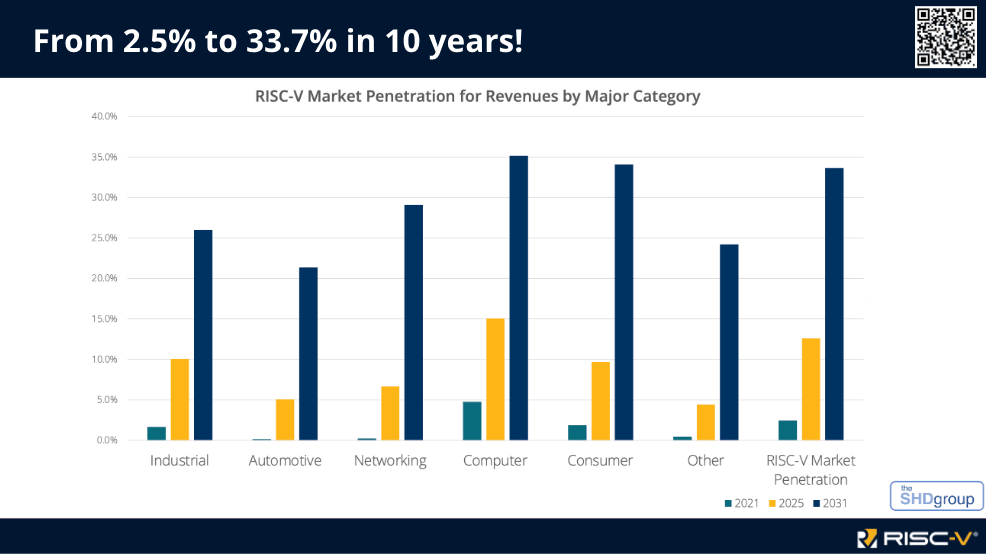
Take its headline forecast that RISC-V-based SoC unit shipments reach 35.9 billion units by 2031, with associated revenues climbing to $318 billion. Before we all pop the champagne, where did those numbers come from?
Methodology Matters
Richard Wawrzyniak, Principal Analyst at The SHD Group and the report’s author, is more than happy to walk me through the methodology.
“It begins with comprehensive top-down and bottom-up analysis,” he says. “This helps us to differentiate our forecast and analysis from other market sources. We try to build in as much granularity as possible.”
To capture the current market, SHD first lists almost 60 different applications (PCs, robotics, smartphones etc.) it identifies as consuming the most silicon. It then breaks this into six vertical markets: Automotive, Computer, Consumer, Industrial, Networking, and a residual “Other” bucket. Within those categories, the top-down step sees them profile system unit shipments for the general market by application. And from there, SHD builds a ‘bill of materials’ of 12 device types per system.
This granularity carries all the way through the report: SHD further segments each application by RISC-V function (Finite State Machine, microcontroller, coprocessor, and host CPU) and splits the vendor landscape into CPU IP vendors, EDA tool providers, software toolchains, and FPGA suppliers. It also tracks the RISC-V CPU IP market as its own line item, separate from the SoC numbers above, forecasting total RISC-V CPU IP revenue to reach roughly $1.9 billion by 2031.
All of this becomes the basis for the bottom-up step, which repeats the exercise but this time asks a narrower question of the same dataset: which of those SoCs use a RISC-V CPU core? By plotting RISC-V based devices against those powered by other ISAs, Wawrzyniak’s team derived a penetration rate for each device type and category.
One of the more distinctive cuts in the report is what The SHD Group calls “AI Functional Levels”. This is a five-tier scale for AI compute capability, running from simple keyword spotting (found in smart speakers) up to large-scale, self-optimizing reasoning systems for mission-critical applications. Then, each tier is mapped to the RISC-V hardware configuration needed to support it (core type, vector extensions, memory hierarchy) rather than to theoretical intelligence milestones, which gives the framework a shelf life closer to that of a hardware roadmap than a software trend curve.
Layered on top of this highly structured quantitative analysis is good old qualitative primary research. The SHD Group says it conducted more than 70 interviews, split roughly 30 in-person and 40 remote, with vendors across RISC-V CPU IP, software, EDA tooling, systems development, and semiconductor devices.
Responses are aggregated and anonymized unless a company explicitly agrees to be named, and some conversations are conducted under NDA. Wawrzyniak is clear that none of this works without that confidentiality: “No analysis is possible without establishing a level of trust between the parties,” he cautions.
Evolving Data Requires a Moving Forecast
 Something I found particularly interesting (and reassuring) is how often the data gets revisited throughout the process, in response to new information and real-world developments during the writing stages.
“We adjust assumptions and forecasts several times, based on new data that we obtain over the course of our effort,” explains Wawrzyniak. “For example, better data we obtained from Chinese companies during our latest research window prompted the team to revise its unit forecast upward.”
Wawrzyniak also recalls closing out the inaugural RISC-V report just as Nvidia’s Frans Sijstermans announced in his RISC-V Summit North America keynote that Nvidia was now using RISC-V microcontrollers in all of its GPUs. In response, SHD worked the Green Team’s GPU revenue into its model in future editions.
A few data points jumped out at me as I read this year’s report, so I thought I’d ask Wawrzyniak to talk me through them…
AI isn’t just driving growth, it’s driving a disproportionate share of revenue.
The report is subtitled “AI is Driving the Growth,” and I don’t doubt that’s true. But I might argue that it’s also true of almost every corner of every industry right now. What interested me more was that RISC-V based AI accelerators will account for roughly 9.06 billion (table 8) of the 35.9 billion (table 14) total RISC-V SoCs shipped by 2031: roughly a quarter of total volume.
But the same category is forecast to generate around $222 billion of the $318 billion in total RISC-V SoC revenue – closer to 70%. Why such a wide gap, I ask Wawrzyniak?
This, he says, comes down to silicon value rather than volume.
“Data center AI accelerators, GPUs, intelligent networking silicon, and advanced edge AI processors are becoming some of the most important revenue contributors in the broader RISC-V opportunity,” he explains. These AI SoCs generally carry far higher die complexity, memory content, and per-unit value than the high-volume, low-cost devices that have traditionally made up RISC-V unit shipments. A comparatively small slice of unit pie buys a very large slice of revenue pie.
RISC-V adoption will vary significantly by application.
While the overall picture of RISC-V adoption is very positive, adoption patterns will vary by application, performance requirement, software maturity, and customer risk tolerance. Wawrzyniak points me to how RISC-V’s own application mix is shifting: The market-share table on page 70 shows the Computer category (historically RISC-V’s stronghold) rising slightly to 72.6% this year, before a slow decline to a forecast 55.0% by 2031, even as this category continues to grow in value from $87.3B to $175.1B.
Of course, that share isn’t disappearing: it’s just being redistributed. Networking climbs from 4.7% in 2026 to 7.9% in 2031, while Consumer grows from 17.5% to 25.5%, and Automotive increases from 2.2% to 3.9% in the same period. Wawrzyniak points to software maturity and risk tolerance as the deciding factors in how fast each of those categories moves. A networking ASIC vendor with an in-house toolchain and a high tolerance for new technology might embrace RISC-V years ahead of an automotive Tier-1 that needs to establish a mature functional safety story first.
Read the RISC-V Market Report 2026 Now
With an outlook as universally positive as it appears in this report, it’s easy to take it all at face value, pop the champagne and ask no further questions. But a forecast is only as useful as your ability to interrogate it, and the more I explored SHD’s methodology, the more I came to appreciate the depth and precision of the analysis behind its forecasts. Knowing that SHD’s numbers are built from a cross-checked, top-down, bottom-up model, tested against 70-plus interviews and revised mid-stream when new data turned up, gives us far more reason to celebrate.
The free, abridged edition of the 2026 RISC-V Market Report is available from SHD’s website under its Market Reports section. A more comprehensive edition, with the full addendum spreadsheet of 338 tables and 298 figures, is also available for purchase.
The SHD Group is looking to establish relationships with more companies in the RISC-V ecosystem to accurately portray the evolution and growth of the RISC-V movement and to tell their stories as they develop. It has accomplished that with the first two reports it has done, and looks to continue this with the next report when it comes out. Please consider connecting with Richard Wawrzyniak and team – your insight will help deliver even more accurate and insightful analysis in future.
My thanks to Richard and The SHD Group for taking me behind the scenes.
Get the Forecast
Click below to access a complimentary copy of The SHD Group’s 2026 RISC-V Market Report.