Project Snapshot
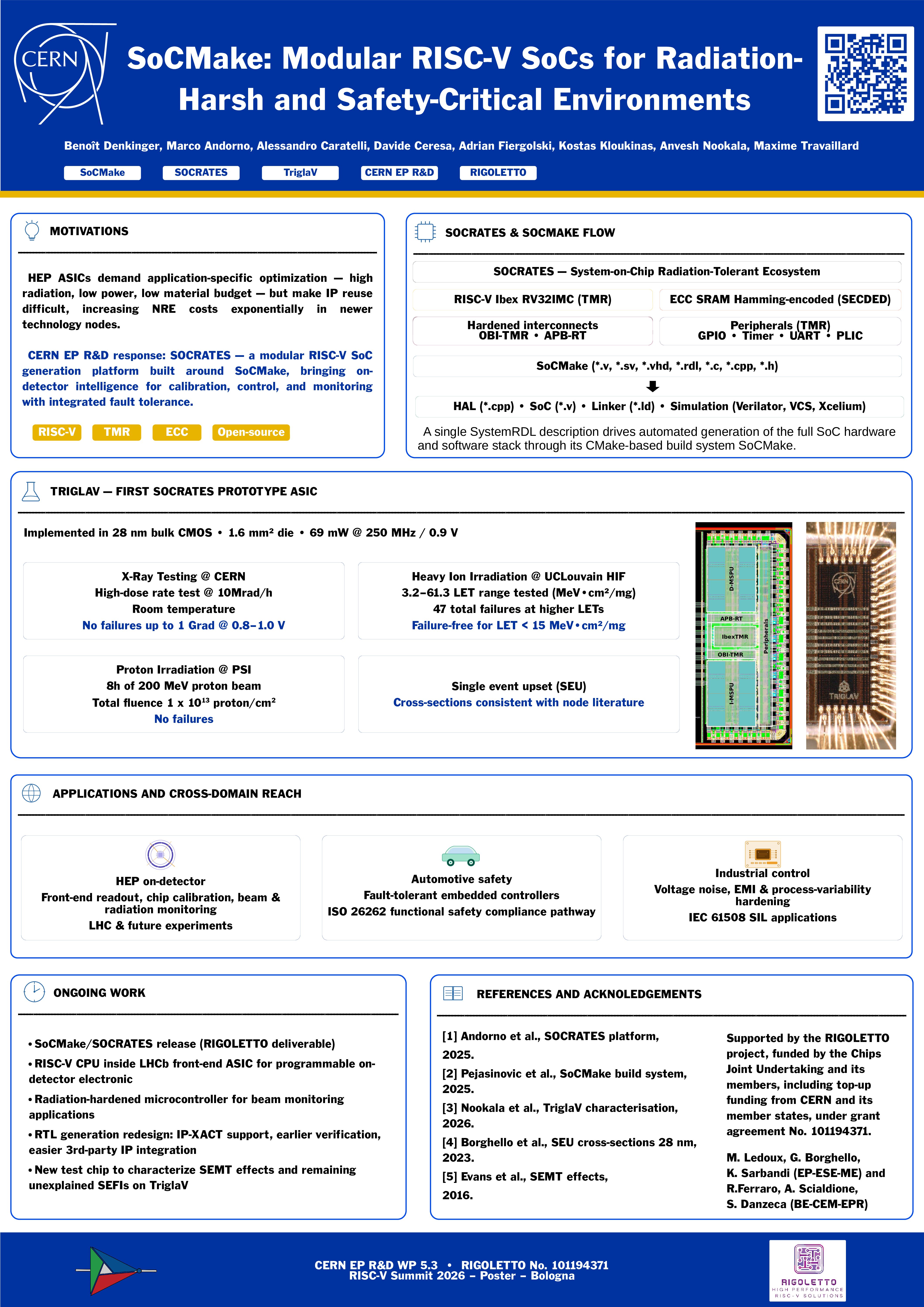
Building on the long-standing use of programmable system-on-chips (SoCs) for edge computing in other domains, this work explores their early adoption in application-specific integrated circuit (ASIC) designs for high-energy physics (HEP) experiments, targeting optimization from design through in-field operation. From front-end detector readout in harsh radiation environments to infrastructure monitoring such as beam and radiation level surveillance, radiation-hardened ASIC SoCs could benefit a range of HEP applications. Current efforts focus on programmable SoCs for control tasks and local data processing such as chip calibration, with physics data processing remaining a longer-term prospect. Beyond HEP, such fault-tolerant techniques, including triple modular redundancy (TMR), hardened interconnects, and memory protection, are equally applicable to safety-critical embedded controllers in domains such as automotive and industrial control systems. In this context, SoCMake, part of the System-on-Chip Radiation-Tolerant Ecosystem (SOCRATES), is being actively developed and used to produce prototype chips. One such chip is TriglaV , a fully radiation-hardened prototype ASIC designed for reliable operation in the radiation environment typical of Large Hadron Collider (LHC) detector front-end electronics. This paper reports on the current status of SOCRATES/SoCMake and the test results of TriglaV, as well as the ongoing work and future directions for the platform.
In Their Own Words
Poster Preview
Meet the Authors

Benoît Denkinger
HW Digital Engineer at CERN in Switzerland
Benoît Denkinger is a hardware digital designer specializing in digital integrated circuits, embedded systems, and RISC-V SoC design. He holds a Ph.D. in Electrical Engineering from EPFL, where his research focused on energy-efficient hardware architectures for edge AI and biomedical applications. He is currently a Digital Design Engineer in the Microelectronics Section at CERN, developing radiation-hardened RISC-V system-on-chips for high-energy physics applications. His expertise includes RTL design, ASIC and FPGA development, and hardware/software co-design for reliable, high-performance digital systems.
Co-authors
Marco Andorno, CERN, Switzerland
Alessandro Caratelli, CERN, Switzerland
Davide Ceresa, CERN, Switzerland
Adrian Fiergolski, CERN, Switzerland
Kostas Kloukinas, CERN, Switzerland
Anvesh Nookala, CERN, Switzerland
Maxime Travaillard, CERN, Switzerland